
McDuffie Court Records After Arrest
In McDuffie County, the jail roster is the first public record many people find after an arrest. It lists the arrest date, arresting or holding agency, total bond, warrant number, statute, charge text, charge class, and the court label shown for each charge. Those entries can point to Superior Court, State Court, Probate Court, or another court field. They are helpful, but they are not the final charging document.
The formal court record is maintained through the McDuffie Clerk of Superior, Magistrate and Juvenile Court. The Clerk states that the office receives, files, stores, and retrieves civil and criminal case records, and that records are open for inspection and copying except juvenile records, adoption records, and records sealed by court order. The McDuffie County jail inmate records page is better for custody and bond roster details, while McDuffie County jail mugshots address booking-photo questions that do not belong in the court case file.
Find McDuffie Court Records After Arrest
Start with the roster only long enough to collect clues. McDuffie roster entries show the arrest date, agency, warrant or case number, statute, charge description, misdemeanor or felony marker, and court. Those fields help decide whether to check the Clerk, Magistrate Court, Probate Court, or the prosecutor's path. A felony or Superior Court label usually means the Toombs Judicial Circuit District Attorney and the Clerk are more important than the roster vendor.
- Open the McDuffie roster entry and copy the name, arrest date, warrant number, statute, charge text, and court field.
- Check the McDuffie Clerk of Superior Court for criminal case-file access when the matter is in Superior, Juvenile, or Magistrate records.
- Use the Georgia Courts E-Access directory route when it points to an available provider, but expect account requirements.
- For a certified record, use the GSCCCA eCertification portal or contact the Clerk directly.
The Georgia Courts directory links McDuffie Superior access to PeachCourt, and PeachCourt help describes a case-search flow by county, court, case number, or party name. The limitation matters: PeachCourt's current criminal access list did not show McDuffie Superior as a current criminal-document access court in the research capture. Treat PeachCourt as a possible access route, not a complete replacement for the Clerk.
The Georgia Courts E-Access page identifies the account-provider path for court access.
Georgia Courts E-Access shows that users may be redirected to provider systems, so a McDuffie County court records after arrest search can require more than one official channel.
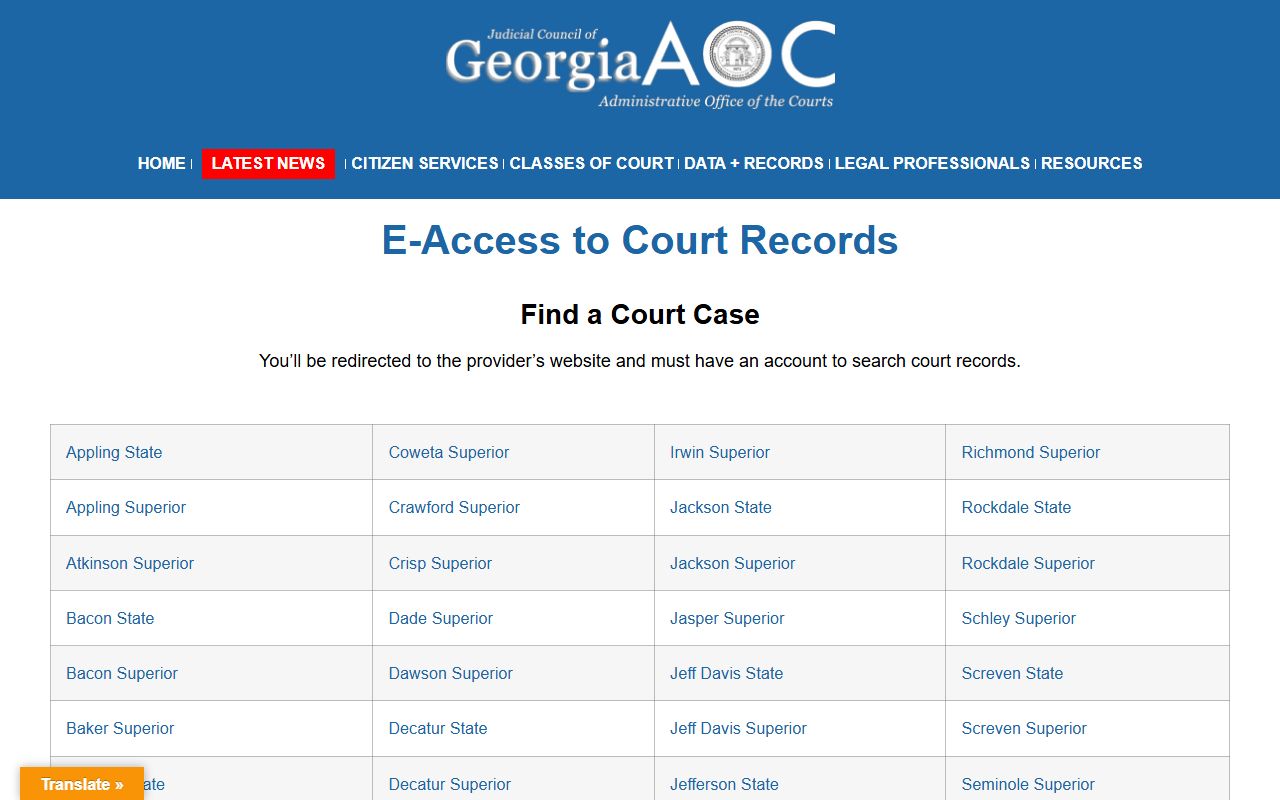
The directory is useful for routing, but the McDuffie Clerk remains the practical fallback when criminal document access is not clear online.
PeachCourt and Clerk Limits
PeachCourt requires an account login. Its captured fields include email or user name, password, sign-in, forgot-password, and register options. Registration asks for identity and security fields, a PIN, reCAPTCHA, and terms acceptance. PeachCourt support says docket data may include assigned judge, case status, co-defendants, prosecuting attorney, defense attorney, charges, disposition, calendar events, proceedings, and documents, but available fields vary by court.
| Access Point | Best Use | McDuffie Limit |
|---|---|---|
| Clerk of Superior Court | Formal criminal case files, certified copies, sealed-record routing | Juvenile, adoption, and sealed files are not open public records |
| PeachCourt | Account-based case search where the court and document type are supported | McDuffie criminal document access was not confirmed on the criminal access list |
| GSCCCA eCertification | Digital certified document requests | It is a document request route, not a free full docket search |
The Clerk's McDuffie eCertification instructions add a local detail: when a case number is not known, the PDF suggests entering any number or the year in the case-number field. That does not create a case search, but it can help complete a certified-document request when the requester already knows the party and document sought.
McDuffie Charging Documents After Arrest
After a McDuffie County jail arrest, the roster may show the early charge basis. The later court record can be based on a complaint or warrant, an accusation filed by the prosecutor, or an indictment returned by a grand jury. Georgia practice uses the word accusation for many non-indictment prosecutions. The Toombs Judicial Circuit District Attorney prosecutes felony state-law charges in McDuffie County and misdemeanors not resolved in probate or city courts.
| Document | Who Uses It | What It Means |
|---|---|---|
| Complaint or warrant | Officer, applicant, magistrate, or prosecutor path | Early arrest or charge basis before the final court filing is clear |
| Accusation | District Attorney | Prosecutor-filed charging document often used when no indictment is required |
| Indictment | Grand jury | Formal felony charging document, common in more serious cases |
The prosecutor is not the custodian of all case files. The DA files and prosecutes charges, while the Clerk stores and retrieves court records. The Toombs Judicial Circuit District Attorney describes prosecution duties for McDuffie and the circuit counties, including felony state-law cases, some misdemeanors, juvenile prosecutions, appellate litigation, and victim-rights work.
McDuffie Charge Status Records
Charge status can change after an arrest. A booking charge can be amended, reduced, dismissed, placed on a dead docket, or resolved by plea or verdict. That is why a McDuffie County court records after arrest search should compare the jail roster with the court docket and, when needed, the prosecutor's filed document. A charge on the jail roster is an allegation, not proof of guilt.
| Status | Plain Meaning | Where to Verify |
|---|---|---|
| Pending | The charge or case is open and not resolved | Clerk docket or court office |
| Amended or reduced | The filed charge changed from the original booking entry | Clerk case file and prosecutor filing |
| Dismissed | The court or prosecutor ended the charge | Disposition entry or order |
| Nolle prosequi | The prosecutor declined to go forward on that charge | Disposition or DA filing |
| Dead docket | The case is inactive but not the same as an acquittal | Georgia court docket and any order |
Georgia Felon Search and GBI criminal-history channels are different from local court docket access. They can help with conviction-focused history, but they are not the best first source for a just-booked McDuffie County jail arrest. Court status is still checked through the local court and Clerk path.
Bond Warrants and First Appearance
Bond and warrants often bridge the jail record and the court record. McDuffie Magistrate Court lists first appearance hearings, criminal warrants, and search warrants among its duties. Georgia law requires a person arrested under a warrant to be brought before a committing judicial officer within 72 hours, with notice of the hearing time and place. Do not apply that rule to every arrest type without checking the facts, because the located statute is warrant-specific.
The sheriff's Jail Division page lists property bond, cash bond, and bail bondsman routes. Property in McDuffie County needs a current tax assessment form or bond letter and valid photo ID. Property in another Georgia county must start through that county's sheriff and be delivered under seal. A cash bond requires the full bond plus processing fee, and a bail bondsman list is handled through the records clerk.
| Issue | McDuffie Source | Why It Matters |
|---|---|---|
| First appearance | Magistrate Court | Early hearing where bond and warrant-arrest issues may arise |
| Bond amount | Sheriff roster and Jail Division | Total bond may show a dollar amount or not set |
| Hold or detainer | Jail and court records | Another agency, DCS, or warrant hold can block release |
No official public online McDuffie warrant-search database was found. For existing warrant questions, use the sheriff, Magistrate Court, or Clerk channel rather than a private warrant site.
McDuffie Charges vs Convictions
A charge is an allegation filed or listed after an arrest. A conviction is the result of a guilty plea, verdict, or other judgment that resolves guilt. The difference is critical for McDuffie County court records after arrest because a person can be booked, charged, released, and never convicted of the offense that first appeared on the jail roster.
| Record Type | What It Shows | What It Does Not Prove |
|---|---|---|
| Charge | An alleged offense, statute, count, and court path | That the person was found guilty |
| Conviction | A final guilt finding, plea, or judgment | That every original booking charge survived unchanged |
For employment, housing, credit, insurance, or tenant screening, casual jail or court lookup is not enough and may not be lawful. FCRA-covered use requires a compliant consumer-reporting process, not a raw public-record search.
Sealed vs Expunged Records
Georgia commonly uses the term record restriction for what many people call expungement. Under the Georgia record-restriction process, eligible arrest and criminal-history information may be restricted from public criminal-history disclosure while remaining available to criminal justice agencies. That is not the same as destroying every court or jail record. Juvenile records, adoption records, and records sealed by court order are also outside normal public inspection through the Clerk.
| Term | Georgia Meaning | Practical Effect |
|---|---|---|
| Sealed by court order | A court limits public access to the file | The Clerk may deny public inspection without the right order |
| Record restriction | Georgia's public criminal-history restriction route | Eligible records may be blocked from public CHRI disclosure |
| Expunged | Common shorthand, but not always literal destruction in Georgia | Use the state restriction process and confirm the exact record type |
The Georgia.gov record restriction page and the GBI record-restriction page are the correct state starting points after dismissal, nolle prosequi, acquittal, or another eligible outcome. A restricted criminal-history entry does not automatically erase a court docket, jail roster trace, or prosecutor file.
Restricted McDuffie Court Records
Some records are limited even when the broader Georgia Open Records Act favors inspection and copying of public records. The Clerk's local access statement excludes juvenile court records, adoption records, and sealed records. The sheriff's records page also warns that pending criminal-case information may require the Clerk and discovery motions, and that some reports can be redacted or exempt unless a court order applies.
Important: Court records after a McDuffie County jail arrest can change after booking, so confirm filed charges and disposition with the office that holds the record.